 AutismologyAutistic studies
Analysis according to Autismology
Reality, frames of reference, socio-generated harms, adaptation and accessibility
This part explicitly constitutes an analysis according to Autismology. Concepts specific to Autistan are presented here as hypotheses and working tools, not as conclusions of the external scientific consensus.
C.1 — Status
This part uses concepts specific to Autistan and Autismology.
They are presented as working frameworks and hypotheses, not as conclusions already established by the external scientific consensus.
The methodological requirement of Part B therefore also applies here: an Autismology hypothesis must be open to discussion, comparison with other explanations and, where appropriate, refutation.
C.2 — The legacy of “withdrawal from reality”
The word “autism” was born within a theory of withdrawal from reality in patients with schizophrenia.
That historical origin has been superseded, but some metaphors persist: “in a bubble”, “in their own world”, “cut off from the world”.
Autismology proposes re-examining this starting point.
A person who does not spontaneously follow a social convention is not necessarily less connected with reality.
They may be less connected with the convention used by the observer to interpret that reality.
C.3 — Reality and conventions
A social convention can be extremely useful without being an objective property of the world.
An implication, a politeness formula, an implicit rule or a social hierarchy can work perfectly for most participants in an interaction.
But if a person does not spontaneously share this code, their divergence does not necessarily demonstrate a general deficit in relation to reality.
It may reveal a difference in frame of reference.
C.4 — Hypothesis of the Natural Referential
Autistan proposes the hypothesis that some autistic characteristics might be better understood as a relationship less automatically mediated by social conventions and more oriented towards certain properties of coherence, precision, continuity, truthfulness or non-arbitrariness.
This hypothesis does not say that autistic people are always right.
It does not create a hierarchy between autistic and non-autistic people.
It seeks to identify differences in processing and reference that may produce reciprocal misunderstandings.
C.5 — The observer is not neutral
When the observer and the autistic person do not give the same meaning to an interaction, the professional or institutional observer generally has more power to impose their interpretation.
A child looks away.
The observable fact is simple: the child’s gaze is not directed at the face.
The interpretation “lack of social interest” already adds a hypothesis.
The child might listen more effectively that way, protect sensory processing, or simply not know the expected social rule.
The Autismology framework therefore asks us to separate observation from the normative commentary added to it.
C.6 — From unilateral deficit to bidirectional misunderstanding
The traditional approach often asks: “why does the autistic person not understand?”
The Autismology approach adds: “why does the non-autistic interlocutor not understand the autistic person?”
Both questions can be valid at the same time.
The interaction becomes a shared object of analysis rather than a simple test of one participant’s functioning.
C.7 — Attitudinal accessibility
Autistic accessibility is not limited to the physical environment.
It may require:
- explicit explanations;
- processing time;
- the possibility of communicating in writing;
- the right to ask for clarification;
- caution when interpreting intentions;
- respect for sensory particularities;
- the possibility of correcting what another person believes they have understood;
- adapting rules when they are unnecessarily implicit.
The problem is therefore not only “how can the autistic person be trained to function in the world?” but also “how can situations be made understandable and practicable?”
C.8 — Interpretive authority revisited
The history of psychoanalysis applied to autism offers a particularly visible example of a more general problem: the risk that the expert’s interpretation replaces the information given by the person.
A sensory complaint can be transformed into a symbol.
A request for clarification into rigidity.
An objection into resistance.
Attitudinal accessibility requires interpretation to remain a hypothesis and the person’s own account to retain the ability to correct it.
C.9 — “Withdrawal” can be protection
A person who isolates themselves may be reducing overload, regaining stability, reducing the amount of information to process, or protecting themselves from an inaccessible interaction.
The outward appearance of “withdrawal” does not identify its function.
The relevant question becomes: what is the person withdrawing from, under what conditions, and what changes when those conditions become accessible?
C.10 — Socio-generated harms
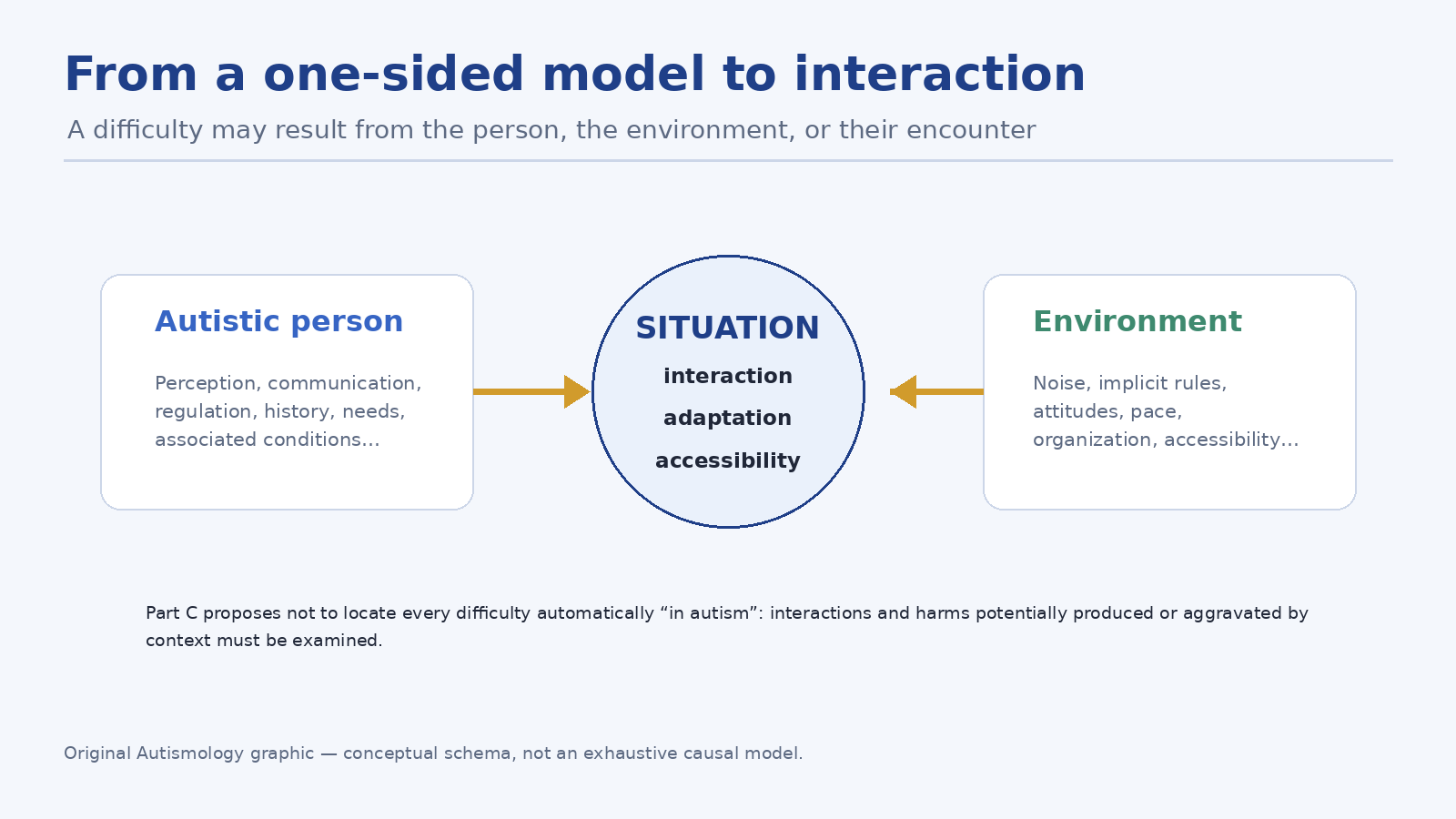
Autismology uses the concept of socio-generated harms to describe difficulties that may be produced or aggravated by repeated interaction with an unsuitable environment.
A person who is constantly misunderstood, forced, exposed to overload, punished for their reactions, compelled to mask, or deprived of accessible means of communication may develop difficulties that are not identical with their initial autistic nature.
This hypothesis does not claim that all autistic difficulties are social.
It claims that it is methodologically incorrect to regard every observed difficulty as intrinsic to autism before studying the interaction with the environment.
C.11 — Autism, difficulties and associated disorders
The Autismology framework proposes distinguishing several levels:
- autistic nature;
- autistic characteristics;
- difficulties directly related to certain characteristics;
- associated disorders or conditions;
- effects of the environment;
- socio-generated harms;
- adaptation strategies;
- consequences of these strategies.
When all these levels are grouped under the single word “autism”, understanding and support become less precise.
C.12 — Psychiatry: treating the precise problem
An autistic person may have depression, psychosis, catatonia or anxiety requiring treatment.
Autismology does not propose abolishing psychiatry.
It proposes identifying the level at which psychiatry intervenes.
Treating depression in an autistic person is not treating autistic existence itself.
And even when individual treatment is useful, it is necessary to examine whether the environment continues to produce or aggravate the difficulty.
C.13 — Adaptation is not assimilation
An autistic person can learn non-autistic social conventions.
This learning can increase autonomy and possibilities.
But learning a convention does not mean that the disappearance of every autistic sign should become the objective.
Autistan therefore distinguishes:
adaptation — acquiring additional means to understand and act;
assimilation — treating the erasure of the autistic way of being as a condition of success.
C.14 — The second-language analogy
Learning a second language does not require destroying the first.
A person can learn majority codes while retaining an autistic way of perceiving, reasoning or communicating.
A possible “autistic accent” may even become a useful signal asking the interlocutor for greater explicitness and caution with implicit meanings.
C.15 — The environment must learn too
If the autistic person has to learn to understand the non-autistic world, the environment can learn to understand:
- sensory differences;
- processing delays;
- atypical forms of communication;
- the need for coherence;
- the effects of overload;
- the risks of erroneous interpretation.
Adaptation then becomes reciprocal.
C.16 — From “correcting the autistic person” to “making the situation accessible”
Changing the frame of reference transforms the practical question.
Instead of asking only “how can we change this person?”, we can ask:
what, in this situation, is preventing this person from understanding, participating or functioning?
The answer may lie in the individual, the environment, or their interaction.
C.17 — Neither idealisation nor pathologisation
Autism should not be reduced to an illness to be eliminated.
But that does not mean that every situation experienced by autistic people is easy or advantageous.
Autismology must avoid two symmetrical errors:
- pathologising everything;
- idealising everything.
A useful approach must be able to recognise difference, disability, distress, abilities, needs, environment and rights at the same time.
C.18 — An Autismology hypothesis must be testable
The history of autism offers a direct warning to Autismology.
A theory can seem coherent and respectful while becoming circular.
We therefore need to ask:
- what would decrease if the environment became more accessible?
- which characteristics would remain stable?
- which phenomena are better explained by sensory, social or medical variables?
- how can a socio-generated harm be distinguished from an intrinsic difficulty?
- which observations would be incompatible with the hypothesis of the Natural Referential?
A hypothesis that could never be put at risk would reproduce precisely one of the problems examined in Part B.
C.19 — The historical shift in the centre of interpretation
The history of autism can be read as a series of shifts:
observed patient → interpreted child → child to educate → diagnosed person → member of a spectrum → person participating in the definition of their own functioning and needs.
Autismology proposes continuing this shift without abandoning scientific rigour: the autistic person becomes an important source of information, but hypotheses must always be confronted with facts.
C.20 — General conclusion
The word “autism” was born in psychiatry as a designation for a supposed withdrawal from reality.
More than a century later, much of the history has consisted in shifting this gaze: from schizophrenia to development, from psychogenesis to neurodevelopmental models, from a narrow category to a spectrum, from the voices of professionals alone to growing participation by autistic people.
Autismology proposes an additional question:
among the difficulties attributed to autism, which belong to autistic nature, which arise from associated disorders or conditions, and which are produced or aggravated by the encounter between that nature and an environment organised mainly according to other frames of reference?
This question is not the definitive conclusion of history.
It constitutes a new programme of investigation.