 AutismologyAutistic studies
Documented history
How autism became “autism”
A.1 — Before the word: people existed before the category
A diagnostic category is not necessary for a human phenomenon to exist.
Historians have sometimes compared older descriptions with what we would now call autism. Among the cases regularly discussed are Hugh Blair of Borgue, in the eighteenth century, and Victor of Aveyron, studied by Jean-Marc Gaspard Itard at the beginning of the nineteenth century.
An obvious trap must nevertheless be avoided: retrospectively diagnosing a person from incomplete documents and according to criteria that did not exist in their time is highly uncertain.
The historical interest of these cases lies elsewhere. They remind us that behaviours now grouped under a category called “autism” may previously have been described within entirely different frameworks: wildness, idiocy, eccentricity, deficiency, madness, developmental delay or peculiarity of character.
Essential historical point: a human reality can precede by centuries the vocabulary used to describe it.

Main sources for this section: S30, S31.
A.2 — Nineteenth century: neurology, psychiatry and emerging classifications
In the nineteenth century, the boundaries between neurology, psychiatry, psychology and philosophy of mind were still shifting.
Jean-Martin Charcot
Charcot (1825–1893) was first and foremost a neurologist. His work at the Salpêtrière concerned neurological diseases, but also hysteria and hypnosis. Freud studied with him in Paris in 1885–1886.
Charcot was not a theorist of autism. His importance here is contextual: he belonged to the intellectual world in which apparently inexplicable symptoms began to be studied at the boundary between the body, the nervous system and psychic life.
Pierre Janet
Janet (1859–1947) developed work on dissociation, psychological automatisms and subconscious phenomena. His work reminds us that the study of non-conscious mental processes did not begin with Freud.
Emil Kraepelin
Kraepelin (1856–1926) played a major role in the formation of modern classificatory psychiatry. He sought to distinguish mental illnesses according to their symptoms, course and prognosis.
His category of dementia praecox would later be reorganised by Eugen Bleuler under the name schizophrenia.
Main sources for this section: S4, S5, S6.
A.3 — Child psychiatry before modern autism
Before autism became stabilised as a distinct category, physicians were already describing various severe childhood clinical pictures.
Sante De Sanctis
At the beginning of the twentieth century, Sante De Sanctis notably used the concept of dementia praecocissima for certain children presenting severe developmental and behavioural disorders.
Theodor Heller
Heller described a pattern of developmental regression that would later be known under several names, including dementia infantilis.
These categories do not simply correspond to present-day diagnoses. Their historical interest lies in showing that the “psychiatric child” gradually became a specific clinical object, while the boundaries between delay, psychosis, regression and atypical development remained highly unstable.
Main sources for this section: S32, S33.
A.4 — Freud: immense influence, indirect link with autism
Sigmund Freud (1856–1939) was a physician and neurologist before becoming the founder of psychoanalysis.
He developed a very broad set of concepts: the dynamic unconscious, repression, transference, infantile sexuality, psychic conflicts, dream interpretation, psychosexual development and several successive models of the psychic apparatus.
Freud did not discover contemporary autism and did not propose a theory of it comparable to later diagnostic conceptions.
His historical link with autism is mainly indirect: the vocabulary of inner life, auto-eroticism and withdrawal formed part of the conceptual environment in which Bleuler created the term Autismus.
Historical archive: Freud Museum London — Freud in England, 1938–39. These documents are offered as biographical archives, not as arguments for or against psychoanalytic theory. [S8–S9]
Main sources for this section: S7, S8, S9.
A.5 — Bleuler: birth of the word “Autismus”
Eugen Bleuler (1857–1939), a Swiss psychiatrist and director of the Burghölzli, transformed Kraepelin’s concept of dementia praecox and popularised the term “schizophrenia”.
It was within this theory of schizophrenia that he introduced the term Autismus.
For Bleuler, autism referred to a predominance of inner life and an alteration of the relationship with external reality in some patients with schizophrenia.
This meaning is fundamentally different from contemporary autism.

Main sources for this section: S1, S2, S3.
A.6 — Jung: at the crossroads of Bleuler and Freud
Carl Gustav Jung (1875–1961) worked at the Burghölzli under Bleuler. In particular, he conducted word-association experiments and worked on “complexes”.
For several years he maintained an important intellectual relationship with Freud before breaking away and developing analytical psychology.
Jung therefore stood historically at a remarkable crossroads:
- Bleuler, who created the term Autismus;
- Freud, whose concepts profoundly influenced twentieth-century psychiatry and psychology.
This explains why his name can appear in a history of autism.
It does not make Jung a founder of the modern conception of autism.
Main sources for this section: S1, S2, S3.
A.7 — Grunya Sukhareva: a long under-recognised history
Grunya Efimovna Sukhareva published detailed descriptions in 1925–1926 of children whose characteristics, in retrospect, strongly evoke contemporary descriptions of autism.
For a long time, her work remained far less internationally known than that of Kanner and Asperger.
Its rediscovery changes the simplified narrative of a sudden discovery of autism in the 1940s.
It also reveals an essential mechanism of scientific history: the circulation of ideas depends on languages, translations, academic networks and geopolitical relations.

Main source for this section: S10.
A.8 — Leo Kanner: 1943 and the construction of a distinct clinical picture
In 1943, Leo Kanner published Autistic Disturbances of Affective Contact, based on a series of eleven children.
His work became one of the major landmarks in the history of diagnosis.
Kanner described a set of characteristics that he considered sufficiently specific to form a distinct clinical picture.
His text already contained the idea of a particularity appearing very early in development. However, Kanner’s later history is more complex than summaries that simply oppose “biological” and “psychological”: some of his remarks about parents would later be taken up in psychogenic contexts, while he rejected simplistic blaming of families.

Main source for this section: S11.
A.9 — Hans Asperger: 1938–1944, then late rediscovery
As early as 1938, Hans Asperger described children whom he called “autistic psychopaths”, and he published a more developed study in 1944.
His work remained little known in the English-speaking world for several decades.
Its history is now also inseparable from research on Asperger’s activity under the Nazi regime and his relationship with institutions involved in the selection and killing of disabled children.
But the story did not end in 1944.
In the 1980s, Lorna Wing strongly reintroduced Asperger’s work into the English-speaking world. In 1991, Uta Frith edited an important English translation of his text. “Asperger syndrome” then entered international classifications before later being merged into the spectrum category.
This is a particularly clear example of how a diagnostic category can be produced not only through clinical observation, but also through the translation, rediscovery and historical rereading of an older text.
Main sources for this section: S12, S13.
A.10 — 1940s–1970s: autism and “childhood schizophrenia”
It is difficult to understand the history of autism if one jumps directly from Kanner to the modern concept of a spectrum.
For several decades, some of the children we would now classify as autistic were still described within the broad framework of psychosis or childhood schizophrenia.
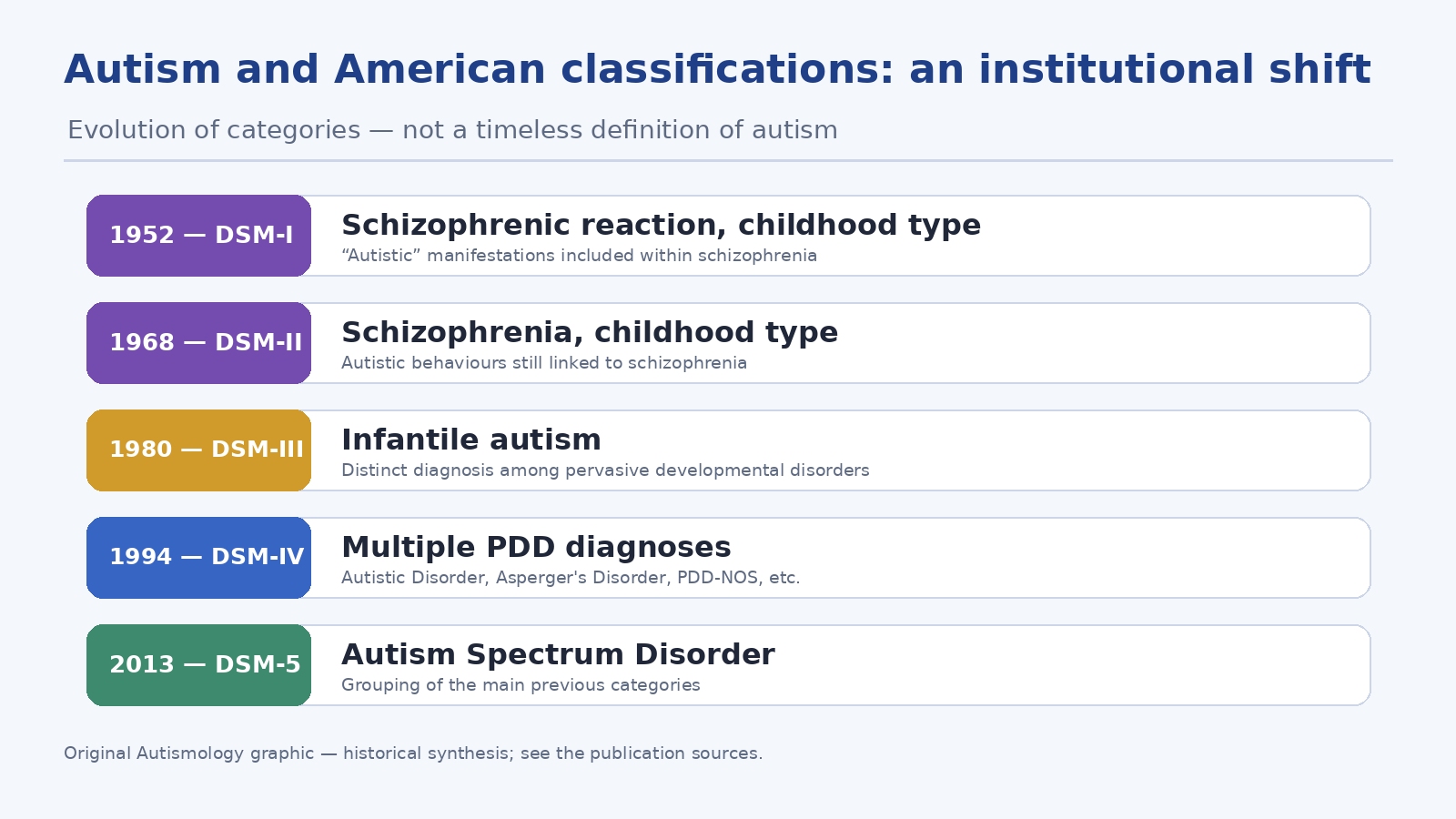
The first DSM editions did not yet recognise autism as an independent category in the modern sense.
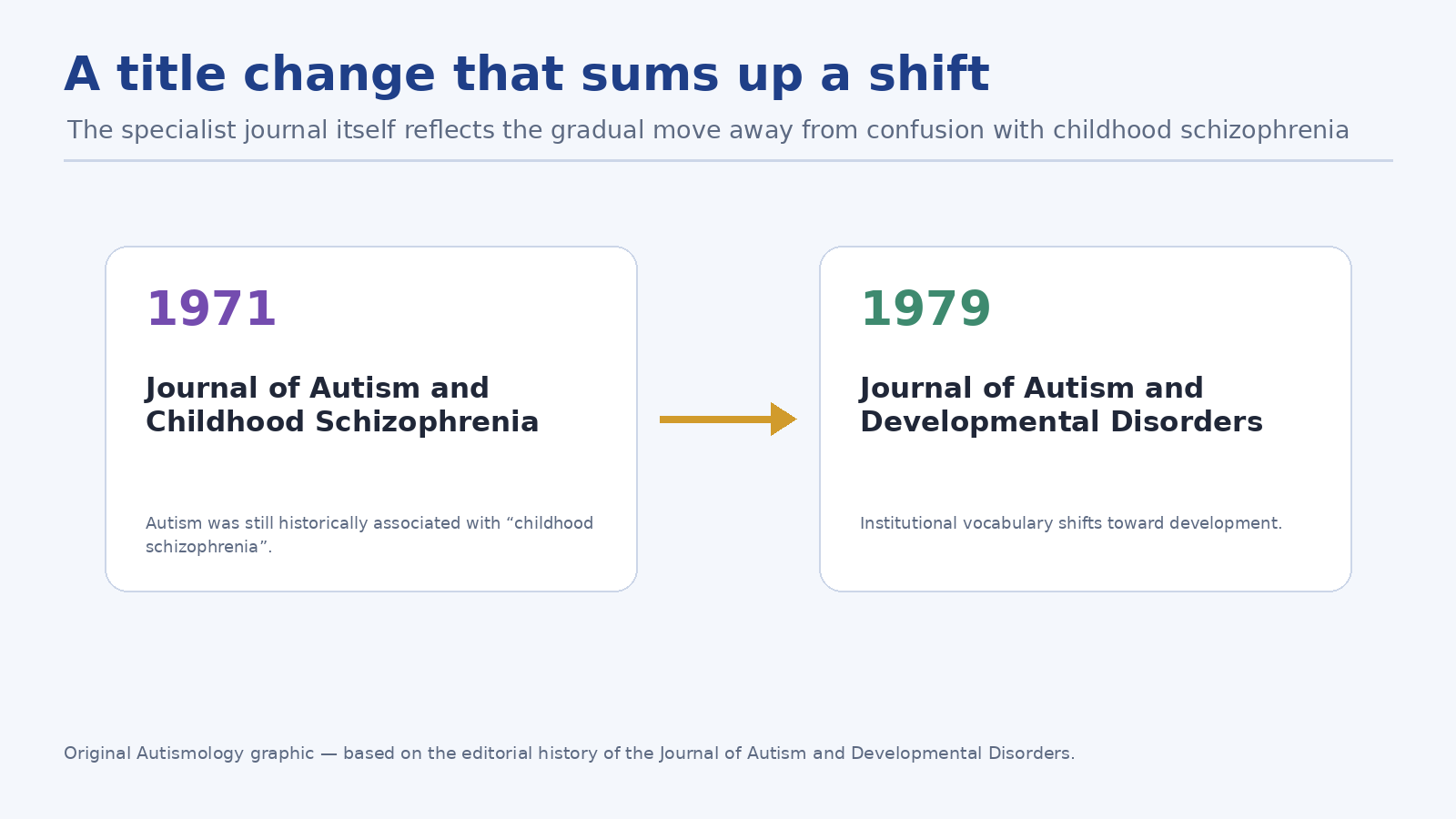
This period is important enough that the scientific journal founded in 1971 was called the Journal of Autism and Childhood Schizophrenia.
In 1979, it became the Journal of Autism and Developmental Disorders.
This change of name almost tells a small history of the paradigm shift by itself:
childhood schizophrenia → developmental disorder.
Main sources for this section: S11, S28, S37.
A.11 — The psychogenic and psychoanalytic period
In several countries and institutions, particularly in the mid-twentieth century, psychoanalytic and psychodynamic models exerted considerable influence.
Autism could be interpreted as:
- childhood psychosis;
- defensive withdrawal;
- a separation disorder;
- a disturbance of the mother-child relationship;
- a problem of access to the symbolic order;
- a particular psychic organisation.
These theories were not identical.
Melanie Klein
Klein played a major role in child psychoanalysis and object-relations theories.
Margaret Mahler
Mahler notably developed a separation-individuation model including a “normal autistic phase”, a historical concept that does not correspond to contemporary autism.
Frances Tustin
Tustin interpreted autism through mechanisms of psychic protection and revised some of her positions over the course of her career.
Bruno Bettelheim
Bettelheim became one of the most famous figures in the dissemination of a psychogenic model and in parental blame, symbolised by the expression “refrigerator mother”.
Jacques Lacan and some French traditions
Lacanian approaches use a different conceptual language, but contributed to the persistence of psychoanalytic readings of autism in some French-speaking contexts.
Main sources for this section: S14, S15, S28.
A.12 — Parents: from accused persons to organised actors
The history of autism is not only a history of physicians and researchers.
Parents played an enormous political and institutional role.
In the 1960s, families began to organise to challenge blame, obtain services, demand appropriate education and create their own structures.
In the United Kingdom, parents participated in founding the organisation that would become the National Autistic Society.
In the United States, Bernard Rimland, Ruth Sullivan and other parents participated in creating the National Society for Autistic Children in 1965, later the Autism Society of America.
The historical reversal is striking:
parents suspected of being the cause → organised parents able to challenge professional authority and demand services.
Audiovisual archive: the National Autistic Society has published the heritage series In Our Words; episode 1 concerns the origins of the organisation and episode 2 diagnosis and the work of Lorna Wing and Judith Gould. These are heritage documents to be read in their historical context. [S46]
Main sources for this section: S34, S46, S48.
A.13 — Bernard Rimland: breaking with psychogenic explanations
In 1964, Bernard Rimland published Infantile Autism and defended a biological conception of autism against the then dominant psychogenic explanations.
His historical role in this break was important, even though some of his later positions would become controversial.
This moment illustrates a general rule in the history of science: a person can play a decisive role in a paradigm shift without all of their later ideas thereby acquiring the same status.
General historical source: S11.
A.14 — Eric Schopler and TEACCH: parents as partners, structured environment
Eric Schopler represents another important historical change.
The TEACCH programme, institutionalised in North Carolina in the early 1970s, broke with several earlier attitudes: parents were no longer treated as the cause of the problem but as partners with particular knowledge of their child.
The approach placed greater emphasis on learning, structuring the environment, visual supports and autonomy.
The change was therefore not only:
psychoanalysis → biology.
It was also:
parents blamed → parents as partners;
interpretation of supposed conflicts → organisation of learning and the environment.
Institutional landmark: TEACCH Autism Program — About Us traces the programme’s institutionalisation in North Carolina and its development from Eric Schopler’s work. [S35]
Main sources for this section: S35, S36.
A.15 — Michael Rutter, Folstein, and the developmental and genetic turn
Michael Rutter contributed strongly to distinguishing autism from childhood schizophrenia and to studying it as a developmental phenomenon.
In 1977, Susan Folstein and Michael Rutter published a twin study that became an important landmark in the history of genetic research on autism.
In this historical article, the aim is not to present the current state of the genetics of autism — that subject belongs to the publication devoted to contemporary knowledge — but to show when and how genetics became a central element in the paradigm shift.
Main source for this section: S16.
A.16 — Wing and Gould: from a narrow category towards the spectrum
In 1979, Lorna Wing and Judith Gould published the Camberwell study.
Their work contributed to the idea that autistic characteristics were not limited to the small group corresponding to the most typical or severe forms recognised up to that point.
Wing later helped bring Asperger back into circulation and develop a broader, dimensional conception.
The move towards the idea of a “spectrum” was therefore not a single event that can be dated to one day. It resulted from changes in observations, categories, diagnostic practices and ideas about continuity between different profiles.
See also: episode 2 of the heritage series In Our Words, devoted to diagnosis and the work of Lorna Wing and Judith Gould. [S46]
Main sources for this section: S17, S18, S46.
A.17 — 1980: DSM-III and institutional separation
The 1980 DSM-III was a major historical turning point: infantile autism became a distinct category within the pervasive developmental disorders.
The importance of this date lies less in the idea that a manual suddenly “discovered the truth” than in the fact that an institutional boundary became much clearer: autism and schizophrenia were no longer treated as belonging to the same diagnostic family.
Main sources for this section: S11, S19.
A.18 — ICD and the internationalisation of categories
Alongside the American DSM, the WHO’s international classifications also evolved.
Autism gradually moved from groupings close to childhood psychosis to developmental categories, and then to the current concept of a spectrum.
The historical interest is to show that this transformation did not occur only in one country or one manual: it gradually became international, even though timelines and categories were not exactly identical.
Main sources for this section: S19, S20.
A.19 — 1980s–1990s: rediscovery of Asperger and multiplication of categories
The English-language dissemination of Asperger’s work helped identify people whose profiles had previously been poorly captured by narrow categories.
Asperger syndrome entered classifications in the 1990s.
Several labels then coexisted: infantile autism, autistic disorder, Asperger syndrome, PDD-NOS, etc.
This multiplication is historically important because it preceded the reverse movement that, at the beginning of the twenty-first century, would group several categories under a spectrum concept.
Main sources for this section: S12, S18, S19.
A.20 — Behavioural interventions and the goal of normalisation
The decline of psychogenic explanations also favoured the growth of educational and behavioural approaches.
They introduced observable objectives, structured learning procedures and more systematic measurement of change.
In some periods and programmes, however, success could be described with expressions such as becoming “indistinguishable from peers”.
Historically, this formulation matters because it shows that changing the causal theory does not in itself eliminate the question of normalisation.
Part B returns to this issue: reducing the visibility of a behaviour is not necessarily equivalent to improving a person’s experience or quality of life.
A.21 — Antipsychiatry, institutions and critiques of medical power
The 1960s and 1970s also saw several critiques of psychiatry and institutionalisation. Thomas Szasz, R. D. Laing, Erving Goffman, Michel Foucault and other authors did not form a single school, but helped bring coercion, institutionalisation, the definition of normality and the power of diagnosis into debate.
These movements are not simply the ancestors of the neurodiversity movement. They belong to a distinct history.
But they helped make thinkable a question that would later return in autistic movements: who has the right to define what an acceptable life is?
A.22 — The 1990s: autistic people become collective actors
One of the most important transformations in the entire history of autism did not concern a diagnosis or a theory.
It concerned who speaks.
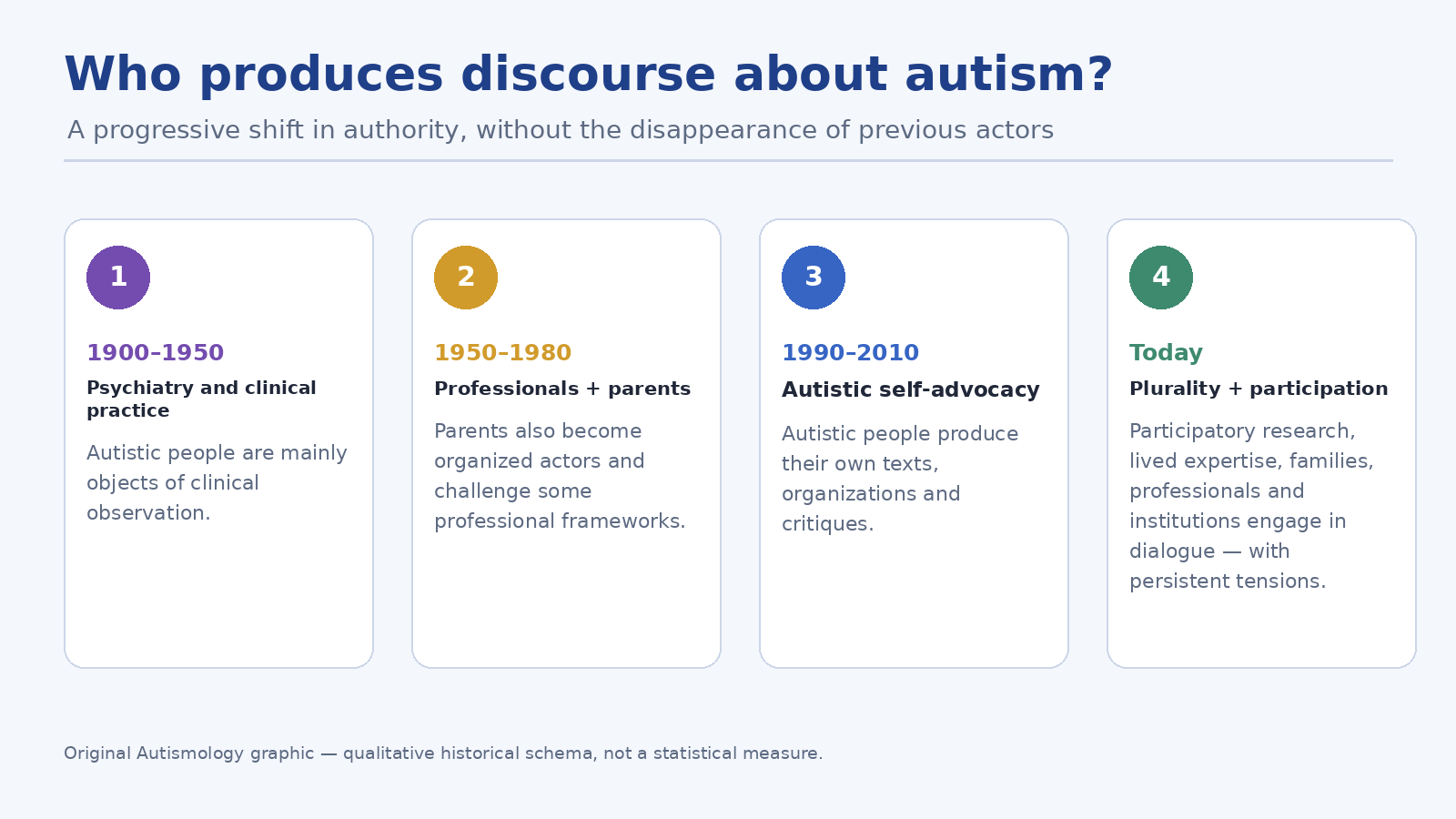
For most of the twentieth century, public discourse on autism was produced mainly by physicians, researchers, psychologists, educators and parents.
In the early 1990s, Autism Network International (ANI) was created by autistic people, including Jim Sinclair, Donna Williams and Kathy Grant.
In 1993, Jim Sinclair presented the text that became famous as Don’t Mourn for Us.
In 1996, Autreat began: a gathering organised to create a social environment more adapted to autistic people.
This change was epistemological as much as political: autistic people were no longer only objects of description or intervention; they became producers of narratives, concepts, organisations and critiques.
Historical document: Jim Sinclair, Don’t Mourn for Us, a text originating in a 1993 presentation and published in the Autism Network International newsletter. [S39]
Main sources for this section: S24, S27, S38, S39.
A.23 — Neurodiversity: emergence of a new political and conceptual language
The term “neurodiversity” emerged in the 1990s in a collective context combining online communities, sociological reflection and activism.
Judy Singer played an important role in its academic use, and Harvey Blume in its journalistic diffusion, but the history of the concept cannot be reduced to the isolated invention of a single person.
In this historical publication, it is not necessary to set out all contemporary positions within the neurodiversity paradigm.
The historical point is this: a new way of speaking about neurological differences appeared and gradually became influential in discussions of autism, disability, identity and rights.
Main sources for this section: S24, S25.
A.24 — 1998–2010: the vaccine controversy as a historical and media event
In 1998, a publication by Wakefield and colleagues in The Lancet helped trigger an international controversy linking the MMR vaccine and autism.
The article was eventually fully retracted in 2010.
The purpose here is not to review all contemporary literature on vaccines and autism. This episode belongs instead to social and media history: a hypothesis concerning autism can acquire considerable cultural and political existence, then continue to circulate long after the scientific collapse of the publication that popularised it.
Chronological landmark: 1998 — publication of the Wakefield et al. article; 2000s — public controversy and investigations; 2010 — full retraction by The Lancet. The interest here is historical and media-related, not a new review of the contemporary literature on vaccine safety. [S41, S47]
Main sources for this section: S41, S47.
A.25 — 2013: grouping under “Autism Spectrum Disorder”
DSM-5 grouped several previous diagnoses under the category Autism Spectrum Disorder.
Historically, the movement was almost the reverse of that of the 1980s and 1990s: after a period of multiplying categories, several of them were brought together under a common spectrum concept.
The purpose here is not to discuss in detail the current validity of this category — that question belongs to the article on the state of knowledge and to other analytical publications — but to mark the endpoint of a long nosological evolution.
Main source for this section: S19.
A.26 — The twenty-first century: participation, research and contestation of goals
In the twenty-first century, autistic people participate more in research, associations, public-policy debates and the definition of priorities.
Discussions increasingly concern:
- participation by the people concerned;
- quality of life;
- accessibility;
- masking;
- late recognition;
- the needs of adults;
- representation;
- the goals of interventions;
- relationships between the medical model, the social model of disability and neurodiversity.
This publication stops here before entering into the detail of these contemporary debates.
They belong to the current state of knowledge and controversies, the subject of a separate publication.
Main source for this section: S26.
A.27 — Where this history brings us
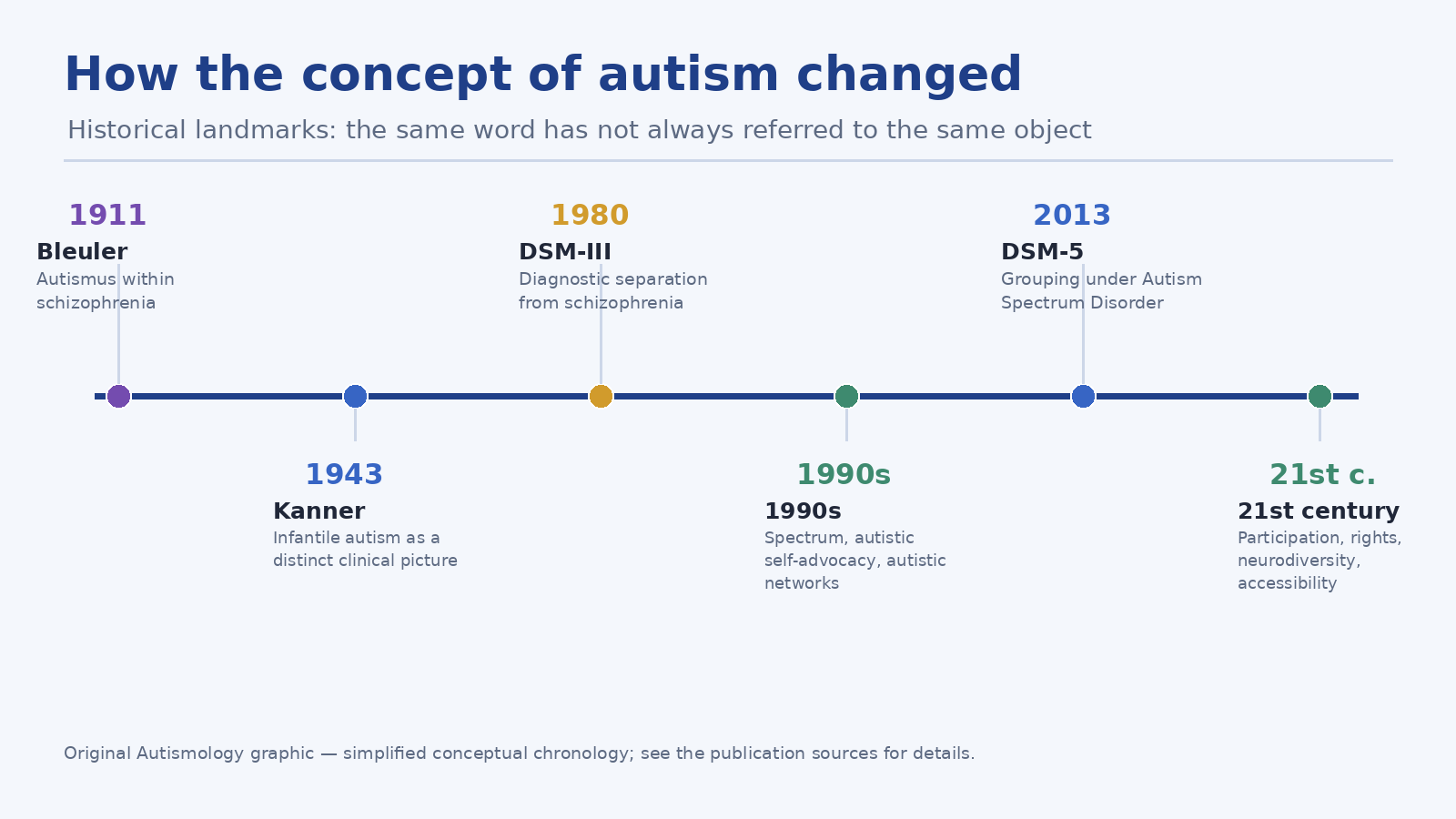
History shows a succession of profound transformations:
symptom of schizophrenia → distinct childhood clinical picture → psychosis / psychogenesis → developmental disorder → multiple categories → spectrum → direct participation of autistic people in defining problems and priorities.
But this chronology does not mean that, at each stage, a total error was replaced by a definitive truth.
It mainly shows that:
- the object studied changes with the tools used to see it;
- vocabulary can survive the theory that created it;
- classifications are historical;
- institutions change what becomes visible;
- the groups concerned can transform the knowledge produced about them.
The question of what is currently known about autism is deliberately referred to the separate contemporary documentary publication.
Part B now examines the reasoning mechanisms that have run through this history.