 AutismologyAutistic studies
Critical examination
Observation, interpretation, causation, power and normalisation
The documentary landmarks used in this part come in particular from sources S7, S11, S14–S16, S19–S23 and S28. The methodological propositions are argued analyses made in this publication.
B.1 — The first danger: reading the past with present-day categories
A sentence by Bleuler containing the word “autism” does not automatically describe contemporary autism.
A psychoanalytic notion of “autism” does not necessarily refer to the same population as a current diagnosis.
A historical category must be understood in the conceptual language of its time before it is compared with a later category.
Anachronism is not a minor issue: it can artificially create a continuity that did not exist.
B.2 — Observation, interpretation and causation
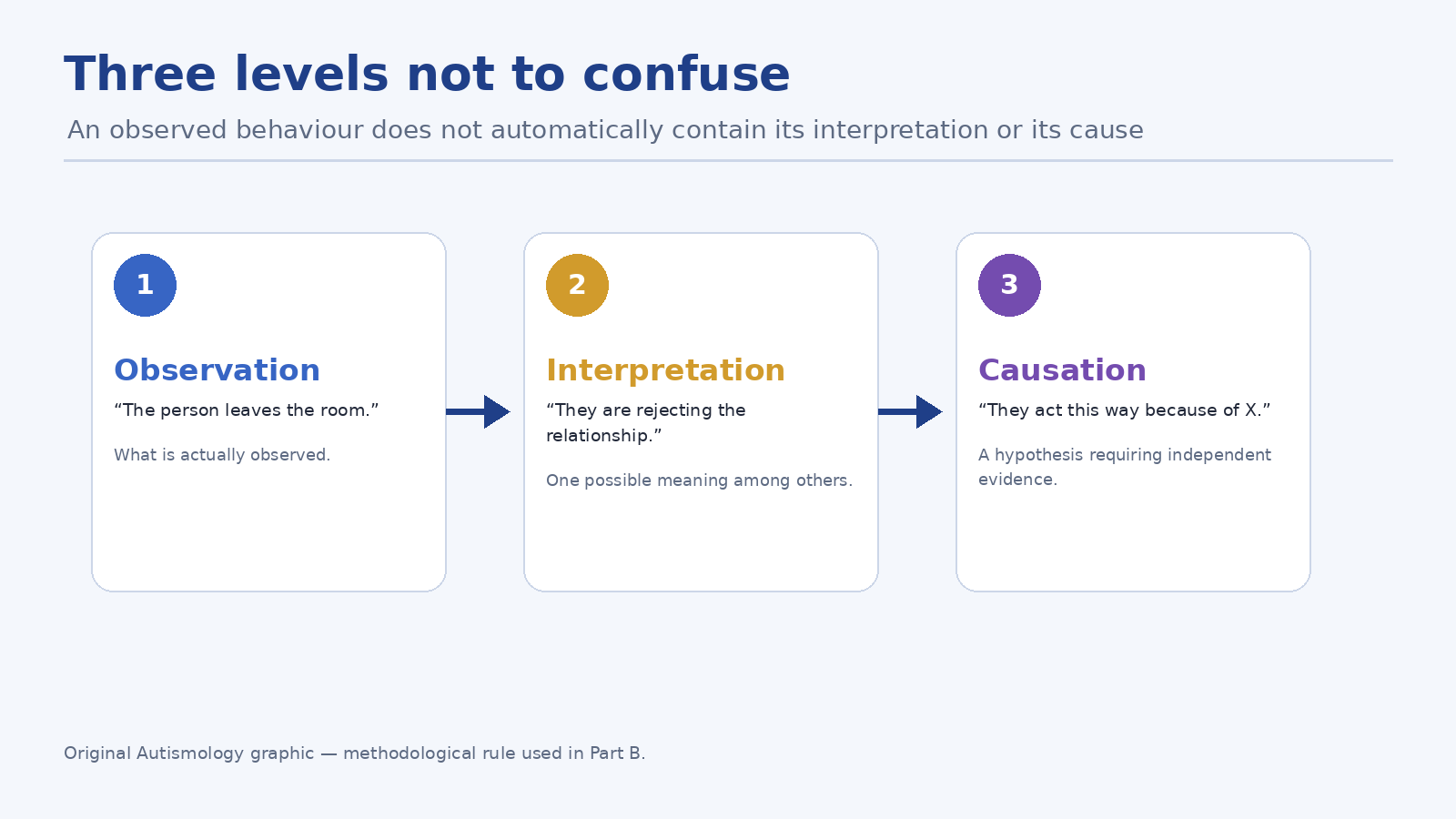
A child does not answer immediately when spoken to: observation.
Saying that the child “refuses the relationship”: interpretation.
Saying that the child refuses the relationship because of an unconscious conflict caused by a parental relationship: causal hypothesis.
These three levels do not have the same status.
The history of autism shows how often they have sometimes been confused.
B.3 — Underdetermination: the same behaviour can have several causes
A person who leaves a room may:
- be experiencing sensory overload;
- be in pain;
- not understand the situation;
- be afraid;
- be tired;
- be trying to regulate their state;
- not want to participate;
- be experiencing a psychiatric difficulty;
- or combine several of these factors.
Observable behaviour does not, by itself, contain its explanation.
The more atypical or inaccessible the person’s communication is to the observer, the more interpretive caution is required.
B.4 — Can a theory be contradicted?
A classic difficulty with some psychoanalytic systems lies in the possibility of interpreting almost every reaction as compatible with the theory.
Agreement may confirm the interpretation; disagreement may be described as resistance.
The philosophical discussion of the falsifiability of psychoanalysis is more complex than the slogans surrounding it, but the methodological question remains essential:
what could force us to abandon our hypothesis?
A theory that allows no clear answer risks becoming a closed system.
B.5 — Interpretive circularity and authority
The danger increases when the theory assigns in advance a meaning to every behaviour: silence, refusal, attachment, repetition, protest.
If the person can never correct the interpretation because their correction is itself interpreted as a symptom, the professional effectively becomes the owner of meaning.
This structure is particularly problematic in autism, where communication differences may already reduce the person’s ability to challenge what is said about them.
B.6 — Individual history and general theory
An autistic person may have traumas, conflicts, defence mechanisms, relationship difficulties and a complex psychic history.
Recognising this psychic life does not demonstrate that these phenomena cause autism.
An explanation that is valid for an individual case does not automatically become a general theory of aetiology.
B.7 — Why could psychogenic models be convincing?
They emerged in a context in which the developmental mechanisms of autism were very poorly understood.
They offered a coherent narrative for behaviours that were not understood.
They belonged to prestigious schools of thought.
They gave the impression of transforming the mysterious into the intelligible.
But the coherence of a story is not a causal demonstration.
B.8 — Parental blame and the impossibility of defending oneself
“Refrigerator mother” theories illustrate the dangers of an asymmetrical interpretive system.
A parent’s protest can be read as denial; acceptance as confirmation.
An accusation that is almost impossible to refute then becomes an institutional mechanism of blame.
The historical role of parent movements should also be understood as a challenge to this power structure.
B.9 — Therapeutic usefulness and theoretical truth
Psychotherapy can be helpful through the relationship, listening, stability, verbalisation or narrative reconstruction without all the causal hypotheses of its school being demonstrated.
“This helps this person” and “this explains the origin of autism” are two independent propositions.
B.10 — The turn to biology does not automatically solve everything
The rejection of psychogenic explanations was an important transformation.
But history should not be told as a simple victory of “science” over “error”, followed by the end of the problem.
A biological theory can also be misinterpreted.
A behavioural intervention can also impose a questionable norm.
A classification can also produce new confusions.
One error can be replaced by another error of a different kind.
B.11 — Visible behaviour and quality of life
The disappearance of a behaviour does not automatically demonstrate improvement.
A person can learn not to show overload without the overload decreasing.
They can produce the expected response while expending considerable effort.
They can stop a self-regulatory movement because it is punished.
The evaluation of an intervention must therefore include its effects on understanding, autonomy, communication, distress, safety and quality of life — not only visible conformity.
B.12 — The problem of normalisation
When an intervention defines success as becoming “indistinguishable from peers”, the reference norm explicitly becomes a non-autistic appearance.
We must then ask: why should resemblance be an objective in itself?
Objectives more directly connected with the person’s interests can be formulated: learning, communicating, understanding, reducing distress, exercising choice, being autonomous, accessing an activity or living safely.
B.13 — Psychiatry: resource or totalising framework?
An autistic person may need psychiatry for depression, psychosis, bipolar disorder, catatonia or a suicidal crisis.
That does not mean that autism itself should be treated as a psychiatric illness to be eliminated.
The methodological distinction is simple:
what exactly is the problem that the intervention claims to treat?
B.14 — Internal symptom or response to the environment?
A difficult behaviour can arise from an internal condition, an unsuitable environment, or an interaction between the two.
Treating only the individual risks making invisible noise, pain, an incomprehensible rule, an abusive relationship, overload or lack of accessibility.
B.15 — Classifications are historical tools
The fact that a classification is official does not mean that it constitutes a definitive ontological description of the person.
It can be useful for communication, organising research and opening access to rights while still having limitations.
The history of the transition from childhood schizophrenia to the spectrum makes this caution particularly necessary.
B.16 — Who produces knowledge?
The entry of autistic people into the production of discourse does not guarantee that every autistic statement is correct.
But it reveals a historical asymmetry: for a long time, the people being studied had very little power over how their behaviours were interpreted.
A science that systematically excluded them from formulating questions and interpreting results would risk losing an essential source of information.
B.17 — Methodological rules derived from this history
- Define the meaning of words in their historical period.
- Separate observation, interpretation and causation.
- Ask what data could contradict the hypothesis.
- Avoid systems in which every challenge becomes confirmation.
- Do not confuse the usefulness of a therapy with proof of its causal theory.
- Do not confuse autism, psychosis and schizophrenia.
- Do not confuse reduction of a behaviour with improvement in life.
- Look for concrete environmental and physical causes.
- Give the person concerned a genuine right of correction.
- Keep every interpretation revisable.
B.18 — Conclusion of Part B
The history of autism is also the history of explanatory frameworks that have sometimes transformed real observations into insufficiently demonstrated causal claims.
The main correction is not to choose a definitive school that would finally possess the whole truth.
It is to continually improve the quality of distinctions: fact / interpretation; characteristic / distress; individual / environment; help / normalisation; difference / associated disorder; diagnosis / lived reality.
Part C examines what this history becomes when the conceptual framework of Autismology is explicitly applied.